Table of Contents
Phantom Stealer is a two-layer Windows infostealer attack chain that uses a malicious pdh.dll loader, process hollowing into jsc.exe, aggressive anti-analysis checks, browser and wallet theft, and a cryptocurrency clipper to steal credentials, financial data, and crypto-related assets while maintaining stealth and persistence.
Key Takeaways
- Two-layer architecture: NativeAOT loader + injected .NET payload
- DLL hijacking and process hollowing for stealth
- 70+ browsers, 30 wallets, 55 wallet extensions targeted
- Crypto clipper, keylogger, screenshots, WiFi and email theft
- Commercial crimeware kit built for reuse at scale
Introduction
A threat actor recently deployed Phantom Stealer, a carefully engineered two-layer attack chain designed to evade detection, survive reboots, and silently steal valuable data from infected systems. The outer loader layer masquerades as a legitimate Windows performance library, while the injected inner payload is a full-featured commercial infostealer sold under the Phantom Softwares (phantomsoftwares.site).
This threat matters for several reasons. The loader uses a rarely seen NativeAOT compilation technique that strips most .NET analysis artifacts, making it invisible to many .NET-aware detection tools. The Phantom Stealer payload goes further than most commodity infostealers: it targets over 70 browsers, 30 desktop crypto wallets, 55 browser wallet extensions, and implements a cryptocurrency clipper for seven different currencies.
Before any visible activity begins, the malware also performs an aggressive self-destruct sequence that checks more than 80 sandbox and researcher identifiers. If the infected host appears suspicious, the malware deletes itself and exits.
What is Phantom Stealer?
Phantom Stealer is a two-layer infostealer attack chain.
The outer layer is a 64-bit NativeAOT-compiled Windows DLL named pdh.dll, designed to be placed in the working directory of an application that loads the legitimate Windows Performance Data Helper (PDH) library. The inner layer is a 32-bit .NET infostealer from the commercial Phantom Softwares crimeware kit, injected into a suspended instance of the legitimate Microsoft process jsc.exe.
This layered design separates delivery and stealth from theft and monetization. The DLL loader handles hijacking, payload decoding, hollowing, and persistence, while the injected payload handles anti-analysis, credential theft, wallet theft, exfiltration, and cryptocurrency clipping.
How Does Phantom Stealer Work?
Phantom Stealer executes in two distinct phases.
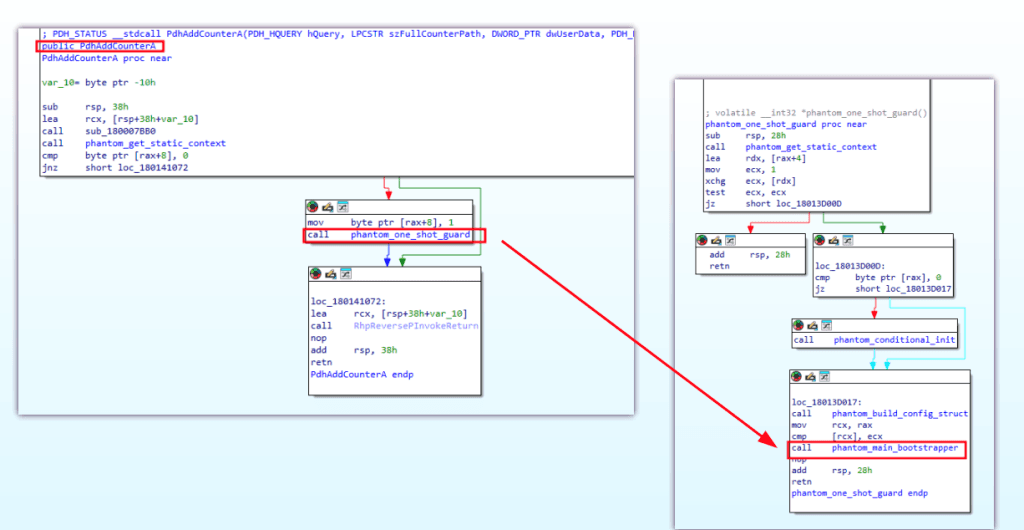
First, the malicious pdh.dll is placed next to an application that loads the legitimate PDH library. This creates a DLL hijacking opportunity. When the victim application calls a PDH function such as PdhAddCounterA, the trojanized export triggers, runs a one-shot guard, decodes the embedded payload using a custom double-RC4 cipher, and process-hollows it into a suspended jsc.exe. At the same time, the loader copies itself to %APPDATA%\Microsoft\RasManagement\MpDlpService.exe and creates a RasManSvc Run key for persistence.
Once jsc.exe is running the injected payload, the Phantom Stealer module takes over. It performs a broad anti-analysis sequence, checking GPU names, process lists, services, IP reputation, machine GUIDs, hostnames, and usernames against hardcoded blocklists. If the system appears to belong to a sandbox or researcher environment, the malware self-deletes. If the checks pass, the stealer decrypts its configuration, optionally delays execution, and begins harvesting credentials, screenshots, wallet data, Wi-Fi passwords, VPN accounts, email data, clipboard contents, and keystrokes. A background clipper thread silently replaces copied cryptocurrency wallet addresses with attacker-controlled addresses. Collected data is archived and exfiltrated over multiple channels.
Why This Matters
Phantom Stealer is not just a password stealer. It is a stealth-focused, persistence-capable theft platform built to abuse both user trust and cryptocurrency workflows.
Technical Analysis
Layer 1: The Loader – NativeAOT pdh.dll Hijacking
Sample Metadata
| Property | Value |
|---|---|
| File | d8a05deefe97c6bbe1e083e9d8a182e6b6e5fbc77af483d2cdef0b4cadec22ce |
| MD5 | FF185B05B231EED98D33239F1B202241 |
| SHA-256 | D8A05DEEFE97C6BBE1E083E9D8A182E6B6E5FBC77AF483D2CDEF0B4CADEC22CE |
| Size | 4,633,088 bytes (4.4 MB) |
| Compiled | 2026-03-08 12:20:43 UTC |
| Architecture | PE32+ (64-bit), NativeAOT .NET DLL |
| Exports | 1 real PDH trigger + ~400 random-name decoy stubs |
The loader is compiled with NativeAOT, Microsoft’s ahead-of-time .NET compiler that produces a native PE binary without standard MSIL or CLR dependencies. This is unusual for malware and removes many of the normal .NET analysis signals. Tools such as dnSpy, ILSpy, and many .NET-focused YARA signatures may fail to recognize it as a .NET sample. According to the draft, NativeAOT runtime symbols such as CoffNativeCodeManager, RhpNewArray, and S_P_CoreLib_* help reveal its origin.
Why This Matters
NativeAOT gives the loader a stealth advantage by making it look like a normal native DLL rather than a typical .NET malware sample.
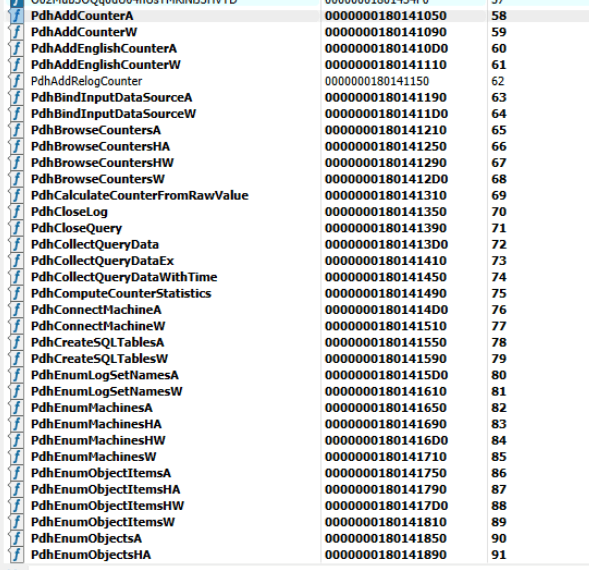
DLL Hijack Trigger
The loader exports the full pdh.dll API surface. When the victim application calls PdhAddCounterA or another PDH function, the malicious export path is triggered and begins the loader execution chain.
String Decryption / Double-RC4
All loader configuration strings are encrypted. The decoder function sub_18013CAE0 follows this sequence:
Base64 string → Base64 decode → sub_18013CC60 → UTF-8 decode → plaintext
sub_18013CC60 implements a double-RC4 transform. A 48-byte key is stored as a 96-character UTF-16LE hex string and split into two 24-byte halves. Each half seeds an independent RC4 S-box, and each ciphertext byte is XOR’d with both PRGA outputs simultaneously.
Recovered 48-byte key (hex):
f9c4f124e2352a08fc5bb645e396e151f2d1f14103acbc79b26558e64431d91b767c8b2466d253651bee4c77b92e8b9b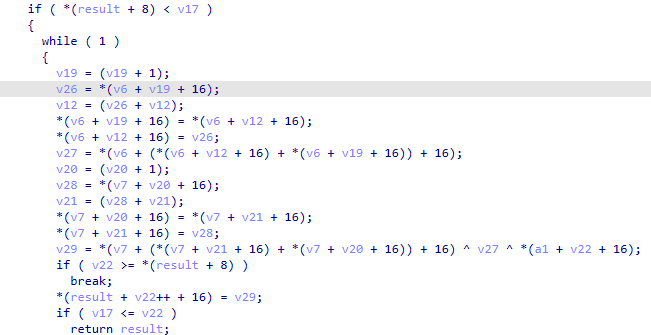
Decoded Loader Strings:
| Decoded String | Role |
|---|---|
pdh.dll | Module name for payload extraction (own DLL handle) |
C:\Windows\Microsoft.NET\Framework\v4.0.30319\jsc.exe | Process hollowing target |
APPDATA | Persistence base environment variable |
Microsoft\RasManagement | Persistence subdirectory |
MpDlpService.exe | Persisted copy filename |
RasManSvc | Run-key value name |
Software\Microsoft\Windows\CurrentVersion\Run | Persistence registry key |
advapi32.dll, kernel32.dll | Dynamically resolved DLL names |
CopyFileW | WinAPI name resolved at runtime (file copy) |
RegCreateKeyExW, RegSetValueExW, RegCloseKey | WinAPI names resolved at runtime (registry) |
bootstrapper started | Bootstrapper entry log |
payload len= / payload empty | Payload extraction status |
inject attempt remaining= | Per-attempt injection status (up to 10 retries) |
inject result= | Injection outcome log |
persistence installed | Persistence completion log |
injection loop done | Post-injection log |
babad | Conditional-init gate string (mutex/named object) |
Why This Matters
The encrypted string handling reduces static visibility and hides key behavioral clues such as persistence paths, injection targets, and API calls until runtime.
Payload Extraction and Encoding
The embedded payload is stored inside the loader image as a nibble-encoded byte stream. The function sub_18013D870 locates marker material inside the loaded pdh.dll, reads the nibble sequence, reconstructs paired 4-bit values into bytes, and returns the raw payload PE.
Process Hollowing into jsc.exe
The malware performs classic process hollowing using a dynamically resolved set of NT APIs. The API names are themselves obfuscated with a byte XOR cipher: decoded[i] = encoded[i] ^ ((0x35 * i + 0x71) & 0xFF).
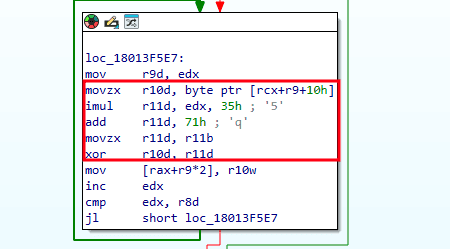
The full API set also gets hollowed (all resolved dynamically at runtime) with up to 10 times retries to handle failures
Persistence
PPhantom installs persistence by:
- copying the DLL to
%APPDATA%\Microsoft\RasManagement\MpDlpService.exe - writing
RasManSvc = (path)underSOFTWARE\Microsoft\Windows\CurrentVersion\Run
The chosen path mimics legitimate Windows naming conventions such as RasManagement and MpDlpService, which helps reduce casual suspicion.
Layer 2: The Phantom Softwares Stealer Payload
Payload Hashes
| File | MD5 | SHA-256 |
|---|---|---|
| Encrypted payload | 12e4b130af651ae53bea75be7fabb751 | c6a2681107ce91ebed93ea0502817025aaf7238db8f96012c389c567904789fa |
| Decrypted payload | aec235738d1c4f06f1b12a8d11a01f4e | d2f509efbdb1d4ae68216807648ea34ba8af5778e1626fc67085b832eebfdc53 |
- Format: PE32 (32-bit), .NET (CLR), GUI subsystem, assembly name
stub - Packed: Costura (Newtonsoft.Json 13.0.0, ICSharpCode.SharpZipLib 1.3.3)
- PE masquerade:
OriginalFilename: svchost.exe,CompanyName: Microsoft Corporation,ProductName: Microsoft® Windows® Operating System,ProductVersion: 10.0.19045.3803
Attribution: Phantom Softwares
The payload contains unobfuscated branding strings that uniquely identify this as the Phantom Softwares commercial infostealer kit:
| String | Purpose |
|---|---|
Phantom stealer | Hardcoded family name |
https://www.phantomsoftwares.site/home | Malware kit website |
https://t.me/Oldphantomoftheopera | Author Telegram contact |
https://www.phantomsoftwares.site/logo/phantom_discord.png | Discord bot avatar |
Anti-Analysis Module (Stub.AntiAnalysis)
The stealer runs a multi-vector pre-execution anti-analysis sequence before starting malicious activity. Each failed check triggers self-destruction. According to the draft, there are 14 distinct self-destruct conditions, including hosting detection, suspicious GPUs, analyst tools, sandbox services, emulator checks, suspicious IPs, blocklisted hostnames, usernames, machine GUIDs, and invalid operator-side exfiltration settings.
Trigger Conditions
| Trigger Condition | String Evidence |
|---|---|
| Cloud/hosting environment detected | AntiAnalysis: Hosting detected! Self-destructing... |
| VM GPU name match | AntiAnalysis: Suspicious GPU detected! Self-destructing... |
| Monitoring process running | AntiAnalysis: Suspicious process detected! Self-destructing... |
| Sandbox service running | AntiAnalysis: Suspicious service detected! Self-destructing... |
| Sandbox environment | AntiAnalysis: Sandbox detected! Self-destructing... |
| Emulator detected | AntiAnalysis: Emulator detected! Self-destructing... |
| Datacenter/VPN IP | AntiAnalysis: Suspicious IP detected! Self-destructing... |
| Blocklisted PC hostname | AntiAnalysis: Suspicious PC name detected! Self-destructing... |
| Blocklisted username | AntiAnalysis: Suspicious PC username detected! Self-destructing... |
| Blocklisted machine GUID | AntiAnalysis: Suspicious Machine GUID detected! Self-destructing... |
| Invalid Telegram config | Program: Invalid Telegram configuration, initiating self-destruct |
| Invalid Discord config | Program: Invalid Discord configuration, initiating self-destruct |
| Invalid SMTP config | Program: Invalid Smtp configuration, initiating self-destruct |
| Invalid FTP config | Program: Invalid Ftp Configuration configuration, initiating self-destruct |
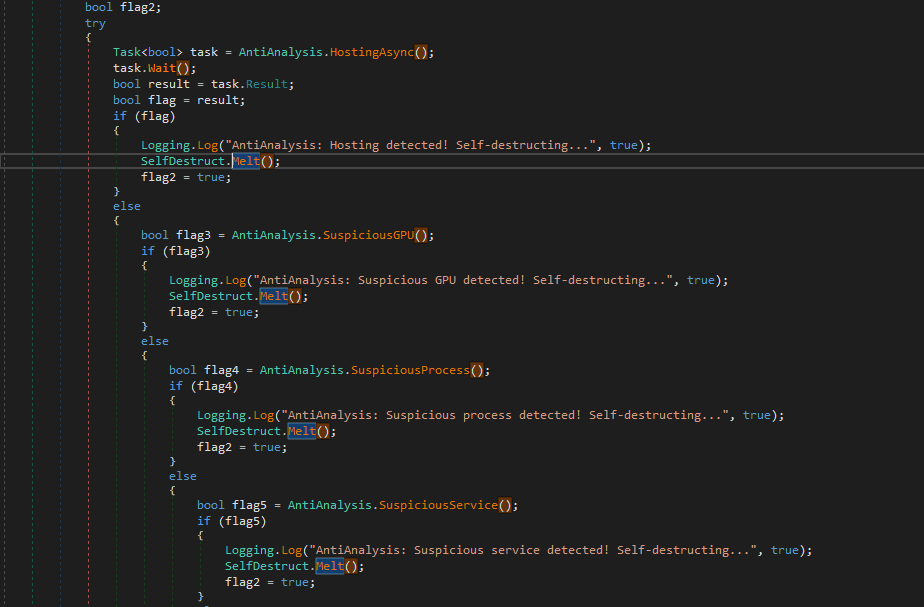
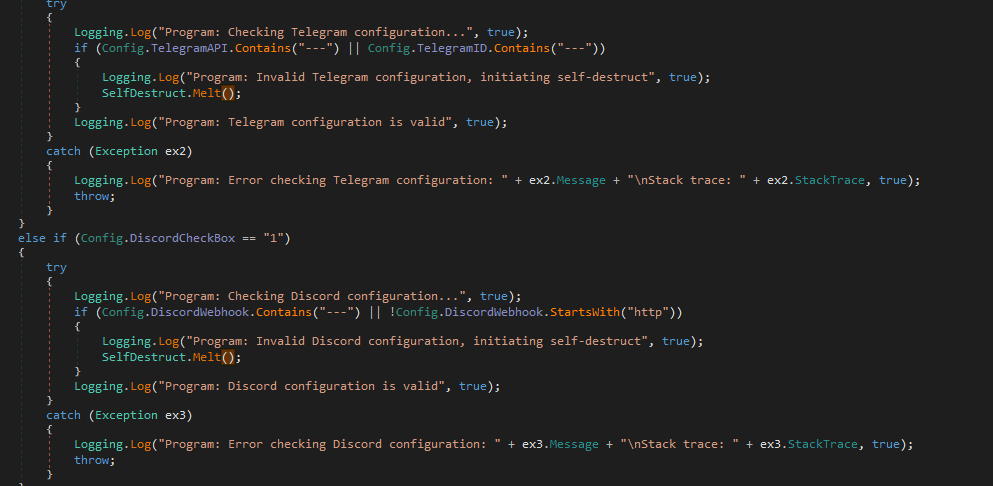
Examples of Anti-Analysis Checks
GPU blocklist (VirtualBox / VMware): VirtualBox Graphics Adapter, VirtualBox Graphics Adapter (WDDM), VMware SVGA 3D, Virtual Desktop Monitor
Suspicious process / service: Sysmon64.exe, VmRemoteGuest.exe
Blocklisted Sanboxes: “SbieDll“, “SxIn“, “Sf2“, “snxhk“, “cmdvrt32“
Blocklisted PC hostnames (80+ entries, sample): DOMIC-DESKTOP, SYKGUIDE-WS17, ARCHIBALDPC, BECKER-PC, BAROSINO-PC, AIDANPC, SERVER-PC, SERVER1, WILEYPC, JOHN-PC, JULIA-PC, MIKE-PC, LISA-PC, LUCAS-PC, NETTYPC, COMPNAME_4047, COMPNAME_4416, COMPNAME_4803, CRYPTODEV222222, JERRY-TRUJILLO, RALPHS-PC, LOUISE-PC, GRAFPC, T00917, WIN-5E07COS9ALR, WINDOWS-EEL53SN, WS-CARROT, ZDS_EDR_14, ZDS_EDR_9, all WINZDS-* variants, and 40+ additional machine identifiers
Blocklisted usernames (sample): HAPUBWS, AppOnFlySupport, User01, Harry Johnson, John Doe, DefaultAccount, WDAGUtilityAccount, Louise, Paul Jones, Frank, Julia
Blocklisted Machine GUIDs (sample): 081ab395-5e85-4634-acdb-2dbd4f59a7d0, 6c5fe7fc-a9c6-46cd-baea-529d2dedc1df, a8844a86-4277-45a7-809c-0c8132e08711, fec973c0-c782-43a8-854c-f9f48d935e0d
Blocklisted IPs (sample): “10.200.169.204“, “104.198.155.173“, “104.200.151.35“, “109.145.173.169“
Blocklisted GPUs (sample): “ZN_TF2UZ", “ZP62XCAP“, “ZSHE4HM“, “Стандартный VGA графический адаптер“
WMI Queries for Environment Detection
SELECT * FROM Win32_VideoController
SELECT * FROM Win32_Processor
SELECT * FROM win32_operatingsystem
Select * From Win32_ComputerSystem
Select * from AntivirusProduct   -- root\SecurityCenter2
Why This Matters
Because Phantom Stealer performs broad environment validation before theft begins, many test environments may never observe the full attack behavior unless they evade the blocklists.
Configuration Decryption
Each Phantom Stealer build carries encrypted operator settings, including exfiltration methods, feature toggles, and clipper wallet addresses. In the analyzed sample, these values were decrypted using AES-256-CBC.
Recovered Operator Configuration
Exfiltration Channels
| Config Field | Enabled | Decrypted Value |
|---|---|---|
TelegramCheckBox | No | (disabled) |
TelegramAPI | No | (disabled) |
TelegramID | No | (disabled) |
DiscordCheckBox | No | (disabled) |
DiscordWebhook | No | (disabled) |
SmtpCheckBox | Yes | (disabled) |
SmtpServer | Yes | mail.taikei-rmc-co[.]biz |
SmtpSender | Yes | New@taikei-rmc-co[.]biz |
SmtpPassword | Yes | e9*w}o;Gm5Zh_2Oc |
SmtpPort | Yes | 587 |
SmtpReceiver | Yes | New2@taikei-rmc-co[.]biz |
CbEnableSsl | Yes | STARTTLS enabled |
FtpCheckBox | No | (disabled) |
FtpHost | No | (disabled) |
FtpUser | No | (disabled) |
FtpPass | No | (disabled) |
The exfil domain
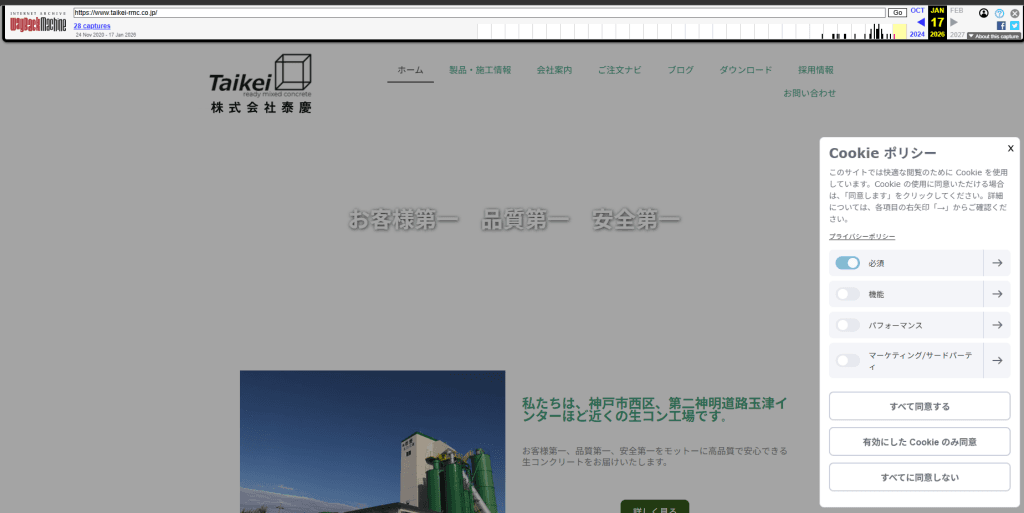
mail.taikei-rmc-co.biztyposquats the legitimate Japanese construction firmtaikei-rmc.co.jp(expired domain). All stolen data is emailed toNew2@taikei-rmc-co.biz.
Theft Module Flags
| Config Field | Value |
|---|---|
Keylogger | "1" |
Screenshot | "1" |
ChromiumBrowser | "1" |
GeckoBrowser | "1" |
OutlookDesktopApp | "1" |
FoxMailApp | "1" |
FileZilla | "1" |
ClipperCheckBox | "1" |
BrowserWallets | "0" |
DesktopWallets | "0" |
Discord | "0" |
Telegram | "0" |
WinScp | "0" |
Clipboard | "0" |
Wifi | "0" |
Note:
Discord/Telegram(theft module flags) are distinct fromDiscordCheckBox/TelegramCheckBox(exfil channel flags). Both are disabled in this build.
Evasion & Persistence Flags
| Config Field | Value |
|---|---|
AntiAnalysis | "0" |
Startup | "0" |
Melt | "0" |
StartDelay | "0" |
Debug | "0" |
File Grabber (Disabled)
| Config Field | Value |
|---|---|
FileGrabberCheckBox | "0" (disabled) |
GrabberHost / GrabberUser / GrabberPass | plaintext empty strings (never encrypted) |
GrabberSizeLimit | 512,000 bytes per file |
| Targeted file types | pdf rtf doc docx xls xlsx ppt pptx indd txt json · db db3 db4 kdb kdbx sql sqlite mdf mdb dsk dbf wallet ini · c cs sln csproj cpp asm sh py pyw html css php go js rb pl swift java kt kts ino · jpg jpeg png bmp psd svg ai |
Downloader (Disabled)
| Config Field | Value |
|---|---|
FileDownloader | "0" (disabled) |
Downloader | plaintext empty string |
Build Metadata
| Config Field | Value |
|---|---|
Version | v3.5.0 |
Mutex | P97KH92W6NXUNLKT9UBI |
Keylogger Target Services
The keylogger captures keystrokes only when the active window title contains terms related to communications, credentials, finance, and cryptocurrency activity. These include:
- social and chat terms:
facebook,twitter,chat,telegram,skype,discord,viber,message - email and access terms:
gmail,protonmail,outlook,email,password,account,login,sign in - banking and payment terms:
bank,credit,card,paypal,shop,buy,sell - crypto-related terms:
bitcoin,monero,litecoin,eth,xmr,wallet,coinbase,crypto,trade,trading, and many others
This targeting suggests the keylogger is designed to focus on windows more likely to contain high-value secrets or financial activity.
Credential Theft Engine
Browser Credential Theft (Stub.ChromiumRecovery + Stub.GeckoRecovery)
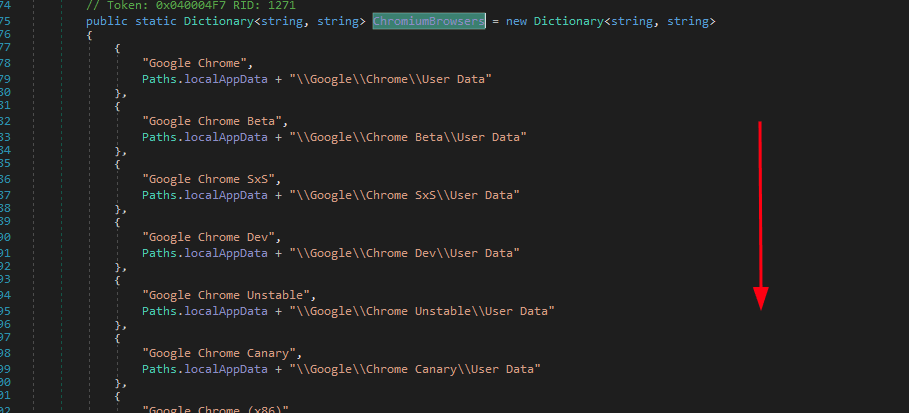
The stealer targets 95+ Chromium-based browsers and 15 Gecko-based browsers. For each profile it extracts: saved passwords (Login Data), cookies (Network/Cookies), credit cards including CVV (Web Data → credit_cards + local_stored_cvc tables), and autofill profiles.
Complete Chromium browser target list (95 browsers): Google Chrome (Stable/Beta/SxS/Dev/Unstable/Canary/x86 variants), Chromium, Microsoft Edge, Brave Browser, Epic Privacy Browser, Amigo, Vivaldi, Kometa, Orbitum, Mail.Ru Atom, Comodo Dragon, Torch, Comodo, 360ChromeX, Slimjet, 360Chrome, 360se6, 360se, 360 Secure Browser, Maxthon (3/5/current), Tencent QQBrowser, K-Melon, Xpom, Lenovo SLBrowser, Xvast, Go!, Safer Secure Browser, Sputnik, Nichrome, CocCoc, Uran, Chromodo, Yandex Browser (Stable/Canary/Dev/Beta/Tech/SxS), 7Star, Chedot, CentBrowser, Iridium, Opera (Stable/Neon/Crypto Developer/GX), Elements Browser, Citrio, Sleipnir5 ChromiumViewer, QIP Surf, Liebao, Coowon, ChromePlus, Rafotech Mustang, Suhba, TorBro, RockMelt, Bromium, Twinkstar, iTop Private Browser, CCleaner Browser, AcWebBrowser, CoolNovo, Baidu Spark, SRWare Iron, Titan Browser, AVAST Browser, AVG Browser, UCBrowser, UR Browser, Blisk, Flock, CryptoTab Browser, Sidekick, SwingBrowser, Superbird, SalamWeb, GhostBrowser, NetboxBrowser, GarenaPlus, Kinza, InsomniacBrowser, ViaSat Browser, Naver Whale, Falkon, SogouExplorer
Gecko-based browsers (15): Firefox, SeaMonkey, Waterfox, Waterfox Classic, K-Meleon, Thunderbird, Epyrus, Interlink, Comodo IceDragon, Cyberfox, BlackHawk, Pale Moon, Basilisk, BitTube, SlimBrowser
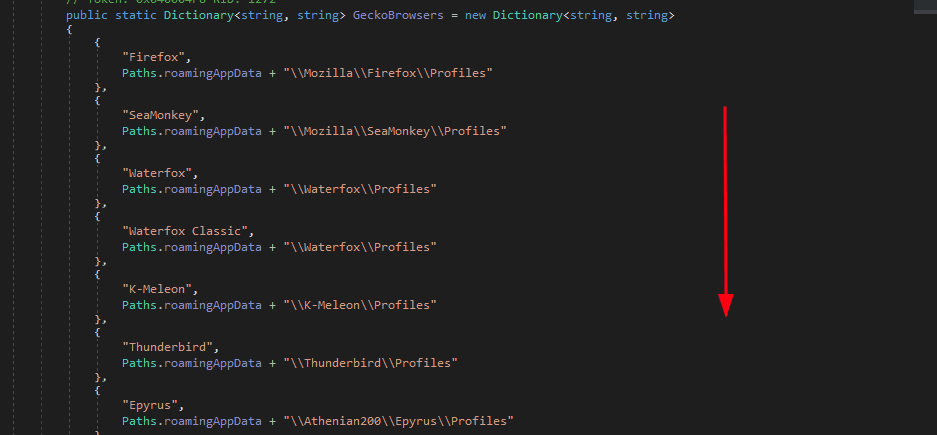
Gecko databases targeted: cookies.sqlite, signons.sqlite, key3.db, key4.db, logins.json
Discord variants targeted for token theft: Discord, DiscordCanary, DiscordPTB, DiscordDevelopment, Lightcord
Discord token regexes:
- Standard token:
[\w-]{24}\.[\w-]{6}\.[\w-]{27} - MFA token:
mfa\.[\w-]{84} - App-Bound encrypted token (Chrome 127+):
dQw4w9WgXcQ:prefix, decrypted viaBrowserCrypto
After token extraction, each token is validated live against https://discord.com/api/v9/users/@me to retrieve username, email, phone number, and Nitro subscription status.
Chrome App-Bound Encryption Bypass
Chrome 127+ protects saved credentials with an App-Bound encryption key that can only be accessed from inside the Chrome process through a privileged COM call. Phantom Stealer bypasses this with a four-part chain:
Stub.HeavensGate— provides a 32-to-64-bit execution bridgeStub.SharpInjector— injects shellcode into a runningChrome.exeInjectionEntryPointDONOTCALL— executes inside Chrome and calls Chrome’sIElevatorCOM interfaces to recover the App-Bound keyStub.AesGcm— decrypts the key using BCrypt AES-GCM
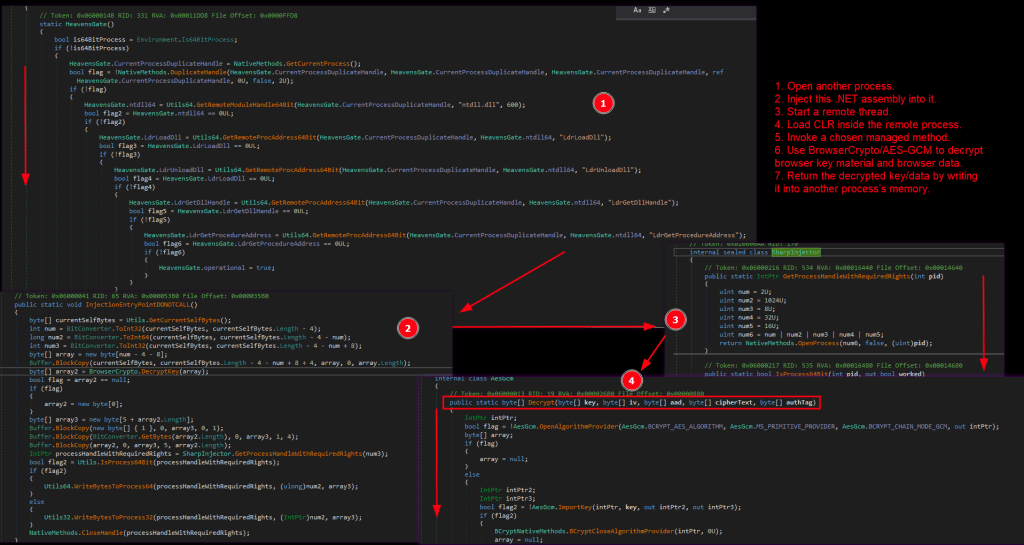
The targeted field is app_bound_encrypted_key inside Chrome’s Local State file.
Why This Matters
Most commodity stealers cannot access Chrome 127+ credentials directly. Phantom Stealer’s ability to bypass App-Bound encryption makes it more capable than many lower-tier stealers.
This bypass targets Chrome’s newest credential protection mechanism (introduced as a response to infostealer proliferation). Most commodity stealers cannot read Chrome 127+ passwords; Phantom Stealer can.
Cryptocurrency Targeting
Desktop Wallet Theft
The stealer copies wallet data directories from %APPDATA% and %LOCALAPPDATA%. Targeted wallets include:
Exodus, Electrum, Electrum-LTC, AtomicWallet, AtomicDEX, Guarda, WalletWasabi, ElectronCash, Sparrow, Coinomi, Binance, TronLink, MetaMask, Jaxx Liberty, TrustWallet, Ethereum keystore, Litecoin Core, Bitcoin Core, Monero, Dogecoin, DashCore, Armory, Bytecoin, IOCoin, PPCoin, BBQCoin, Mincoin, DevCoin, YACoin, Franko, FreiCoin, and others.
Browser Wallet Extension Theft (55+ extensions)
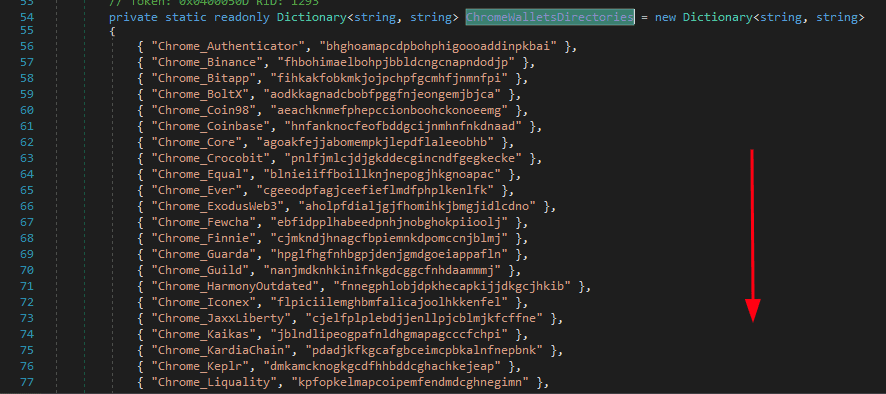
The stealer targets 55+ wallet extensions in Chrome and additional wallet extensions in Edge. Data is collected from Local Extension Settings and IndexedDB directories inside browser user profiles.
Chrome targets include: Authenticator, Binance, Bitapp, BoltX, Coin98, Coinbase, Core, Crocobit, Equal, Ever, ExodusWeb3, Fewcha, Finnie, Guarda, Guild, HarmonyOutdated, Iconex, JaxxLiberty, Kaikas, KardiaChain, Keplr, Liquality, MEWCX, MaiarDEFI, Martian, Math, Metamask, Metamask2, Mobox, Nami, Nifty, Oxygen, PaliWallet, Petra, Phantom, Pontem, Ronin, Safepal, Saturn, Slope, Solfare, Sollet, Starcoin, Swash, TempleTezos, TerraStation, Tokenpocket, Ton, Tonkeeper, Tron, TrustWallet, Wombat, XDEFI, XinPay, XMR.PT, Yoroi, iWallet
Edge wallet extensions targeted: Auvitas, Math, Metamask, MTV, Rabet, Ronin, Yoroi, Zilpay, Terra Station, Jaxx
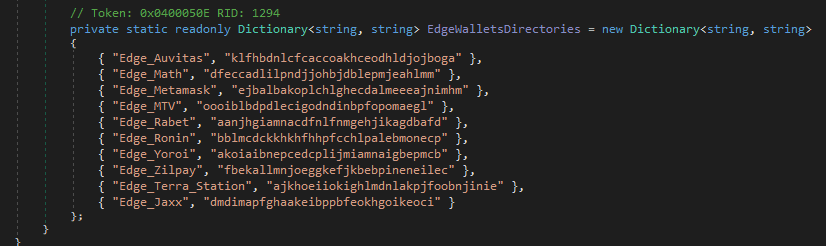
Extension data is collected from Local Extension Settings and IndexedDB subdirectories within each browser’s User Data profile.
Cryptocurrency Clipper
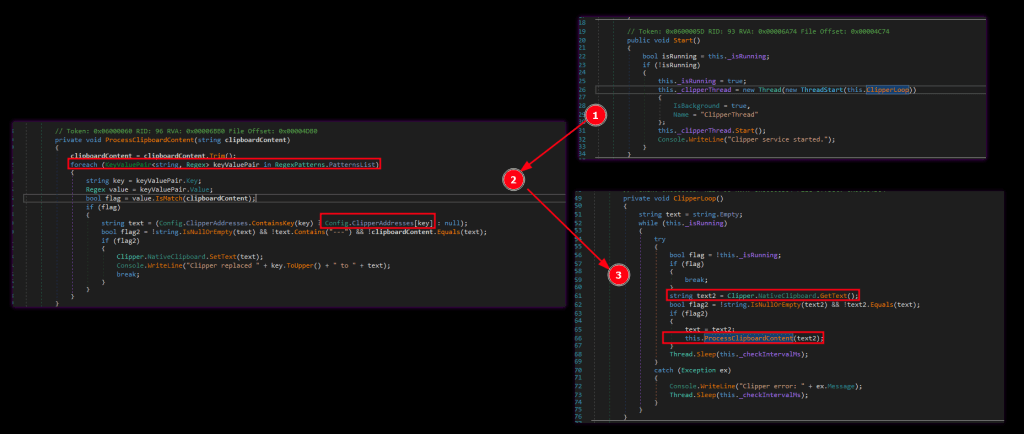
The clipper runs in a dedicated background thread (ClipperThread) and monitors clipboard content continuously. When it detects a cryptocurrency address matching one of the following regex patterns, it replaces the clipboard content with the operator’s configured address (decrypted from AES-256-CBC config at startup):
| Cryptocurrency | Detection Regex |
|---|---|
| Bitcoin (BTC) | ^(bc1[qp]|[13])[a-km-zA-HJ-NP-Z1-9]{25,59}$|^bc1[ac-hj-np-z02-9]{8,87}$ |
| Ethereum (ETH) | ^(0x)?[0-9a-fA-F]{40}$ |
| Litecoin (LTC) | ^[LM3][a-km-zA-HJ-NP-Z1-9]{26,34}$ |
| Bitcoin Cash (BCH) | ^(bitcoincash:)?([qp][a-z0-9]{41}|[QP][A-Z0-9]{41})$ |
| Monero (XMR) | ^[48][0-9AB][1-9A-HJ-NP-Za-km-z]{93}$ |
| Tron (TRX) | ^T[a-zA-Z0-9]{33}$ |
| Solana (SOL) | ^[1-9A-HJ-NP-Za-km-z]{44}$ |
Operator’s configured replacement addresses:
| Currency | Operator Wallet Address |
|---|---|
| BTC | bc1qq8zs0ngk6t0ergwdknpc9m4e46pgnnns47h9er |
| ETH | 0x7e3205A62FCf14a1d50aA7A58B6aE7daC471Ae9e |
| LTC | LaGNPik4pQrsipv6tXm8YCaMn3T6ZmcHyt |
| BCH | qq0zxsskgel7vurzqyzdkmepwjunp5vwgvvdlvudkv |
| XMR | 47NagK8jt1U6UoTzU7mFXPghQbodptiyBZB7MVkxZFyYXpUfJqHAFUR71TH6pTZub13zZS8hz4M6YTuytGwpefVTT8sS1Bc |
| TRX | TDLVU9c84owCjrKCiHXK27zdLefnM5g941 |
| SOL | B7VfhomCgQXkWeLXKUB7MVrDA7iRHQ5rRMwZ2swad8pL |
Why the Clipper Matters
The clipper silently replaces any cryptocurrency address the victim copies, even if the original address came from a trusted site or application. The victim may still believe the address is correct and unknowingly transfer funds directly to the attacker. This attack works without requiring a browser extension and can affect any application that uses the clipboard.
Keylogger
The keylogger installs a WH_KEYBOARD_LL low-level keyboard hook using SetWindowsHookEx. Every keystroke is captured by LowLevelKeyboardProc / HookCallback, converted into a readable string by GetKeyString, and written to a log file through SaveToFile.
Special keys are recorded with descriptive labels such as:
[BACKSPACE][CAPSLOCK][PAGEDOWN][PRINTSCREEN][NUMLOCK][SCROLLLOCK]
Example log format:
{0}_{1:yyyyMMdd_HHmmss}.txt
The keylogger runs in a dedicated thread and is controlled by a feature flag:
- Keylogger: Enabled
- Keylogger: Disabled
Why This Matters
The keylogger gives operators access to typed credentials, messages, and financial input that may never be stored in a browser.
Screenshot Module
The screenshot module runs in its own background thread (ScreenshotThread) and captures the full primary screen at a hardcoded 30-minute interval. Screenshots are saved as PNG files in the hidden working directory using the format::
{MachineName}_{yyyyMMdd_HHmmss}.png
Why This Matters
Periodic screenshots give the operator visual access to sensitive activity that may not be recoverable from browser databases or logs alone, including dashboards, internal tools, crypto wallets, and email sessions.
Clipboard Logger
Separate from the cryptocurrency clipper, Phantom Stealer also includes a clipboard logger. This component continuously monitors clipboard content and logs all captured text entries to a file. The log format is:
--- Clipboard Entry [2026-05-01 14:23:11] ---(clipboard content)
Status string:
Captured clipboard content. Total words: {count}, saved to file via SaveToFile.
Why This Matters
The clipboard logger broadens theft beyond cryptocurrency. It can capture copied passwords, account numbers, API keys, customer records, email content, and other sensitive text users copy during normal workflows.
WiFi Credential Theft
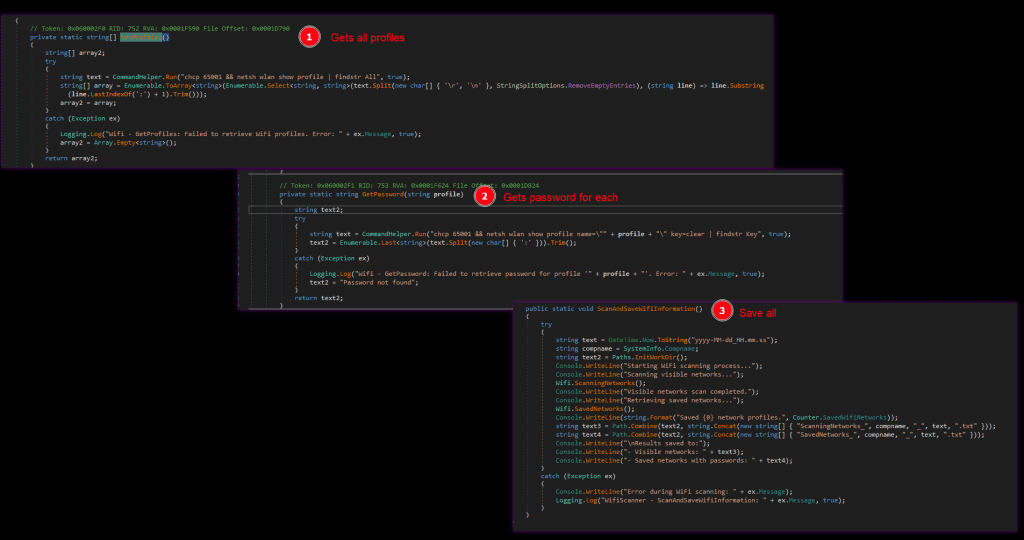
Phantom Stealer harvests WiFi credentials by executing shell commands through cmd.exe. The commands include:
chcp 65001 && netsh wlan show profile | findstr Allchcp 65001 && netsh wlan show profile name="<SSID>" key=clearchcp 65001 && netsh wlan show networks mode=bssid
The results are saved to:
ScanningNetworks.txtfor nearby networksSavedNetworks.txtfor stored WiFi profiles and passwords
Output files use timestamped naming patterns such as:
SavedNetworks_{timestamp}
ScanningNetworks_{timestamp}
Why This Matters
WiFi credential theft can expose shared network access and help attackers move beyond the current host into physical or office-network environments tied to the victim.
FTP Client Credential Theft
FileZilla
The stealer reads stored server credentials from filezilla.xml in %APPDATA%\FileZilla\. It parses XML fields including:
ServerOutgoingServerOutgoingPortAccountPassword
The extracted report is saved to a timestamped FileZilla_<timestamp> file.
WinSCP
The stealer reads saved WinSCP session data from these registry paths:
Software\Martin Prikryl\WinSCP 2\SessionsSoftware\Martin Prikryl\WinSCP 2\Configuration\Security
Fields parsed include:
HostNameUserNamePortNumber
Recovered data is saved to WinScp_<timestamp>. If WinSCP is protected by a master password, the malware fails gracefully and records that session recovery is not possible.
Why This Matters
FTP and SCP credentials can expose servers, staging environments, internal file stores, and operational infrastructure that attackers can use for follow-on access or data theft.
Email Client Credential Theft
Phantom Stealer targets multiple email clients and credential sources.
| Client | Access Method | Registry Path / Location |
|---|---|---|
| Microsoft Outlook 2013 | Registry | Software\Microsoft\Office\15.0\Outlook\Profiles\Outlook\9375CFF0413111d3B88A00104B2A6676 |
| Microsoft Outlook 2016+ | Registry | Software\Microsoft\Office\16.0\Outlook\Profiles\Outlook\9375CFF0413111d3B88A00104B2A6676 |
| Windows Mail | Registry | Software\Microsoft\Windows Messaging Subsystem\Profiles\9375CFF0413111d3B88A00104B2A6676 |
| Foxmail | Registry | SOFTWARE\Classes\Foxmail.url.mailto\Shell\open\command |
| Generic SMTP/POP3/IMAP | Memory fields | SMTP Server, POP3 Server, IMAP Server, POP3 Password2, SMTP Password2 |
| Thunderbird | Profile directory | %APPDATA%\Thunderbird\Profiles |
Why This Matters
Email access is high-value because it can expose credentials, customer communications, password resets, financial workflows, and internal operational context far beyond the infected endpoint.
Telegram Session Theft
The stealer locates the Telegram Desktop tdata/ session directory through the registry entry tg\DefaultIcon and copies the session files. This allows session hijacking without knowing the account password.
Status string:
Telegram data successfully saved to: {path}
Why This Matters
Telegram session theft can give attackers direct access to live communications, groups, shared files, and operational chats without triggering a normal password-based login flow.
File Grabber
The file grabber collects files matching configurable extension lists across four categories:
| Category | Report Label |
|---|---|
| Images | 💳 Images |
| Documents | 💬 Documents |
| Databases | 🖥️ Databases |
| Source Codes | (SourceCode category) |
Extensions are controlled through the encrypted configuration (Config: Begin Decrypting Grabber details). Collected files are archived as:
Grabber_{hostname}_{timestamp}.zip
The archive is then uploaded through FTP using the configured GrabberHost, GrabberUser, and GrabberPass values. The feature is controlled by a dedicated flag.
Why This Matters
This feature expands Phantom Stealer beyond credentials and wallets into document theft, database theft, and source code theft, which raises both espionage and extortion risk.
Downloader Module
The downloader module (FilelessDownloaderAsync) retrieves a payload from an operator-configured URL, decodes it from Base64, and executes it entirely in memory, without writing a new file to disk. Status strings include:
[*] Downloading payload...[*] Decoding payload...[*] Detecting architecture...[*] Attempting in-memory execution...
Execution path:
VirtualAllocPAGE_EXECUTE_READWRITENtCreateThreadEx
Fallback:
- .NET reflection-based in-memory execution if the primary path fails
The module also handles architecture mismatches between 32-bit and 64-bit execution contexts.
Why This Matters
This allows operators to push additional payloads, including ransomware, RATs, or secondary stealers, to already-compromised systems without dropping a new file to disk, which helps evade file-based detection.
System Information Collection
The following fields are included in the exfiltration report sent to the operator:
- date/time
- OS name and architecture
- username
- hostname
- language / country
- antivirus
- gateway IP
- local IP
- external/public IP
Email subject line format:
{username}/ {hostname} - {month}.{day}.{year}
Why This Matters
This system profiling helps operators prioritize victims, understand the environment, and organize stolen data for follow-on exploitation or resale.
Indicators of Compromise (IOCs)
File Hashes
| File | MD5 | SHA-256 |
|---|---|---|
| Loader (pdh.dll) | FF185B05B231EED98D33239F1B202241 | D8A05DEEFE97C6BBE1E083E9D8A182E6B6E5FBC77AF483D2CDEF0B4CADEC22CE |
| Encrypted payload | 12e4b130af651ae53bea75be7fabb751 | c6a2681107ce91ebed93ea0502817025aaf7238db8f96012c389c567904789fa |
| Decrypted payload | aec235738d1c4f06f1b12a8d11a01f4e | d2f509efbdb1d4ae68216807648ea34ba8af5778e1626fc67085b832eebfdc53 |
Network Indicators
| Indicator | Type |
|---|---|
mail.taikei-rmc-co[.]biz | C2 Domain |
New@taikei-rmc-co[.]biz | Email IOC |
New2@taikei-rmc-co[.]biz | Email IOC |
phantomsoftwares[.]site | Domain |
www.phantomsoftwares[.]site | Domain |
t[.]me/Oldphantomoftheopera | URL |
File System Indicator
| Path | Description |
|---|---|
%APPDATA%\Microsoft\RasManagement\MpDlpService.exe | Persisted loader copy |
Registry Indicator
| Key | Value |
|---|---|
HKCU\SOFTWARE\Microsoft\Windows\CurrentVersion\Run | RasManSvc |
Crypto Wallet Addresses
| Currency | Address |
|---|---|
| BTC | bc1qq8zs0ngk6t0ergwdknpc9m4e46pgnnns47h9er |
| ETH | 0x7e3205A62FCf14a1d50aA7A58B6aE7daC471Ae9e |
| LTC | LaGNPik4pQrsipv6tXm8YCaMn3T6ZmcHyt |
| BCH | qq0zxsskgel7vurzqyzdkmepwjunp5vwgvvdlvudkv |
| XMR | 47NagK8jt1U6UoTzU7mFXPghQbodptiyBZB7MVkxZFyYXpUfJqHAFUR71TH6pTZub13zZS8hz4M6YTuytGwpefVTT8sS1Bc |
| TRX | TDLVU9c84owCjrKCiHXK27zdLefnM5g941 |
| SOL | B7VfhomCgQXkWeLXKUB7MVrDA7iRHQ5rRMwZ2swad8pL |
YARA
YARA Rule 1: Loader Layer (NativeAOT pdh.dll Hijack)
rule Windows_Loader_PhantomStealer
{
    meta:
        description = "Phantom Stealer NativeAOT pdh.dll Sideloading Loader"
        author      = "Dark Atlas; @ELJoOker"
        date        = "2026-05-05"

    strings:
        $s1         = "DotNetRuntimeDebugHeader" ascii
        $s2         = "PdhAddCounterA" ascii
        $s3         = "PdhGetCounterInfoA" ascii

    condition:
        uint16(0) == 0x5A4D and
        uint16(uint32(0x3C) + 0x18) == 0x020B and
        (
            ($s1 and $s2 and $s3) or
            ($s1 and $s2)
        )
}
YARA Rule 2: Payload Layer (Phantom Softwares Stealer)
rule Windows_Stealer_PhantomStealer
{
    meta:
        description = "Phantom Softwares Stealer .NET Payload (Phantom Stealer v3.5.x)"
        author      = "Dark Atlas; @ELJoOker"
        date        = "2026-05-05"

    strings:
        $s1         = "Phantom stealer" wide
        $s2         = "phantomsoftwares.site" wide
        $s3         = "Initiating self-destruct" wide
        $s4         = "app_bound_encrypted_key" wide
        $s5         = "ClipperThread" wide
        $s6         = "HeavensGate" ascii
        $s7         = "DecryptByteDesCbc" ascii
        $s8         = "Oldphantomoftheopera" wide
        $s9         = "P97KH92W6NXUNLKT9UBI" wide

    condition:
        uint16(0) == 0x5A4D and
        uint16(uint32(0x3C) + 0x18) == 0x010B and
        (
            ($s1 and $s2) or
            ($s1 and $s3 and $s6) or
            ($s2 and $s7 and $s5) or
            ($s9 and $s6 and $s4 and $s8)
        )
}
FAQ
What is Phantom Stealer?
Phantom Stealer is a two-layer Windows infostealer chain that uses a malicious pdh.dll loader and an injected .NET payload to steal credentials, browser data, wallet data, and cryptocurrency-related assets.
How does Phantom Stealer infect systems?
It abuses DLL hijacking by placing a malicious pdh.dll where a legitimate application loads it. The loader then decodes the embedded payload and process-hollows it into jsc.exe.
Why is Phantom Stealer difficult to analyze?
The loader uses NativeAOT, encrypted strings, and a separate injected payload. The stealer also performs extensive anti-analysis checks and can self-delete before the visible theft stage begins.
What does Phantom Stealer steal?
It steals browser credentials, wallet data, screenshots, email and VPN-related data, tokens, clipboard contents, and keystrokes. It also runs a cryptocurrency clipper.
Why is the clipper dangerous?
Because it changes copied cryptocurrency addresses in the clipboard, the victim can unknowingly send funds to the attacker even when copying from a trusted source.
Conclusion
Phantom Stealer is confirmed to be an actively distributed infostealer with working, real-world functionality. The loader layer abuses DLL search order hijacking to silently deliver the Phantom Softwares payload, a commercial crimeware kit that appears to have been developed with strong attention to completeness and evasion.
This sample represents a professionally assembled two-layer intrusion kit. It uses DLL hijacking as a quiet delivery mechanism, hides indicators behind a double-RC4 string protection scheme, and injects the payload into a hollowed jsc.exe process via direct NT API usage. Its coverage is broad: browser theft, desktop cryptocurrency wallets, clipboard hijacking, keylogging, screenshots, email client theft, WiFi credential theft, Telegram session theft, and optional in-memory payload delivery.
The most important threat multiplier is the kit’s commercial nature. The same payload family can appear across many campaigns with different operator credentials, exfiltration settings, and wrapper layers. That makes Phantom Stealer more than a single malware sample, it is part of a reusable crimeware ecosystem built for scale.